
The Woodlands Previous Resident Sources
Previous residents research begins by placing one address in time. Most The Woodlands parcels route through Montgomery County, while Creekside Park routes to Harris County. Modern recorded instruments, property records, Township GIS, archives, newspapers, and genealogy collections overlap, but their coverage is not the same. Start with the source closest to the period you are testing. The online official-records portal is useful for modern indexed instruments. Earlier Montgomery material has a separate microfilm route through the Texas State Library and Archives Commission.
| Source | Period or access point | Where held | What it can show |
|---|---|---|---|
| Official Records index | Modern indexed instruments | Montgomery County Clerk portal | Instrument, date, parties, type, legal-description text |
| Deed Record | 1838 to 1887 | TSLAC Montgomery County microfilm | Recorded land trail, subject to missing-volume cautions |
| Deed of Trust Record | 1872 to 1891 | TSLAC microfilm | Trust instruments and a partial index route |
| Conroe directories | 1984, 1988, 1990, 1992 | TSLAC Austin reading room | Regional historical directory leads |
| Courier and genealogy collections | Historical and current archive routes | MCMLS Genealogy Center | Context, maps, published notices, and catalog leads |
Neither a deed nor a directory entry proves a continuous household history. Treat each dated entry as a lead, then compare its address, legal description, and date to the next source in the sequence.
The Woodlands Deed Chain Walkback
The best route to past residents of a property starts with the current parcel record and then moves backward through recorded transfers. Use the property record to collect the legal description and parcel identifiers. In the Montgomery County Official Records Search, search the present owner or entity, subdivision, document type, document number, recorded date, or legal-description terms. Search Index Only is a clean first pass. Search Index and Full Text can reach OCR text, but it may return false matches from scan recognition.
- Confirm the county, parcel identifier, current legal description, and present appraisal context.
- Find the most recent relevant instrument and record its number, type, date, grantor, grantee, volume or page, and image state.
- Search the seller as a grantee to find the prior acquisition, using the legal description when a name search is weak.
- Repeat the documented handoff backward, keeping spelling and date differences rather than silently merging them.
- Move to TSLAC microfilm when the online index does not answer the earlier period, and note the index gaps before treating a negative result as final.
This Official Records Quick Search view shows the Montgomery County portal used for the first documented pass in a previous-residents trail for The Woodlands.
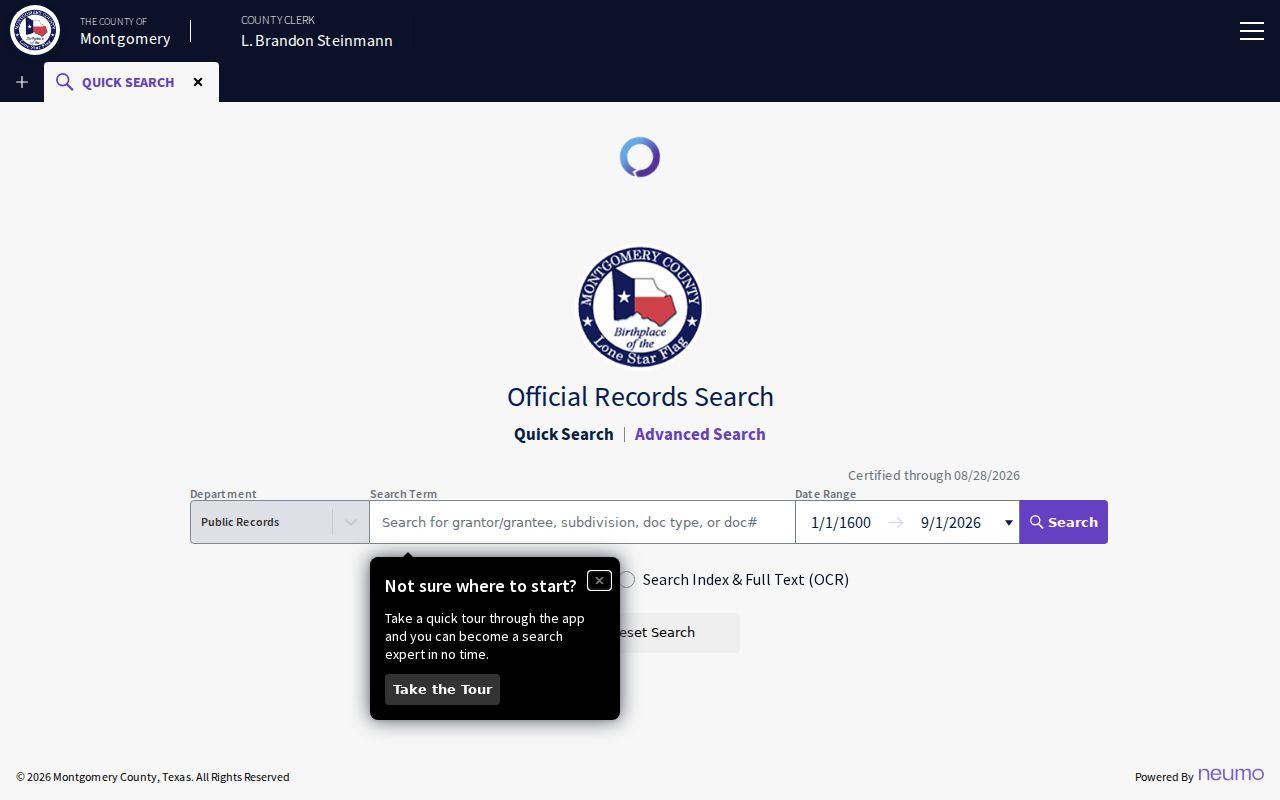
Use the portal’s recorded-date range and index or OCR choice to narrow a search, then preserve the instrument details before moving backward to the prior transfer.
For a plain or certified copy, the County Clerk copy request requires a signature, a check with the requester’s name, address, and phone, a legible ID copy, and a self-addressed stamped envelope. It lists $1 per page plus $5 for a certified copy and estimates 24 to 72 hours. Mail or take the request to the Montgomery County Clerk, 210 W. Davis Suite 100, Conroe, TX 77301. The office phone is 936-539-7885; confirm hours before a visit.
The Woodlands Previous Microfilm
The TSLAC Montgomery County inventory supplies the historic fallback that a modern portal cannot replace. It lists Deed Record coverage from 1838 through 1887. Direct and reverse index reels are 1006024 and 1006025, with record reels beginning at 1006026. The inventory also flags missing Volumes G and I and other indexing limitations. Those notes belong beside any unsuccessful search, because no portal result does not show that an instrument never existed.
For prior residents research, the direct and reverse indexes are valuable because a chain can be approached from either party after a known transfer is found. Copy the name spelling exactly as it appears in each index, then compare the land description before assuming the next record refers to the same tract. The Woodlands itself began in 1974, but Montgomery County land records predate that development by more than a century. Older county material may describe land before it became a planned-village parcel.
The Woodlands Previous Deed Gaps
Deed-of-trust records add a second historical path, but the access notes are not seamless. TSLAC lists Deed of Trust Record coverage for 1872 through 1891 on reels 1006041 through 1006043. The listed index for 1883 through 1915 is on reel 1006041. Volumes A through D, plus pre-1883 Volume E, are not indexed in the inventory. A missing index entry in those periods is therefore a research limit, not a conclusion about an address or a person.
The archive inventory also identifies Montgomery marriage records from 1838 through 1916 and probate minutes from 1838 through 1906. Those collections can provide family or estate context after the land chain identifies a likely period, but they are not substitutes for the deed trail. Use the actual county or archive source, preserve the date and record type, and do not turn a historical association into a current address claim.
The Woodlands Past Resident Directories
The exact local directory shelf is narrower than many searchers expect. TSLAC located Conroe holdings for 1984, 1988, 1990, and 1992. It did not locate an exact The Woodlands directory run on its authoritative holdings page. The directories are consulted in the Austin reference reading room, and TSLAC staff do not search or transcribe entries by phone or email. That makes the page, edition year, and repository as important as the name found on it.
Use those Conroe editions as regional leads, not as a promise that every The Woodlands address appears. The state library’s directory guide says an entry may show name, address, telephone, spouse, occupation, or tenure notation. A historical entry indicates a dated publication presence. It does not establish current residence. The collections, access rules, and reading strategy are described in more depth on the The Woodlands city directory page.
The Woodlands Past Courier
The Montgomery County Memorial Library System offers another dated layer. Its digital newspapers page reports historical Courier archive coverage from 1925 through 1983, searchable Courier coverage from 2008 to the present, and daily browsable images from 2018 forward. Search a surname, village, subdivision, public meeting date, or legal-description clue, then record the publication date, page or image, and the type of item found.
A newspaper is a lead, not a replacement for the property record. Confirm a reported transfer in the County Clerk index and confirm a family or estate event in the appropriate original record. That small discipline helps separate a notice, advertisement, obituary, report, or editorial from an established fact in an address history.
The Woodlands Covenant Deed Clue
The founding land history creates a useful comparison point for previous residents research. The Township’s WCA covenants document ties the covenants to a January 11, 1974 deed in Volume 841, pages 297 through 352. It is a development and land-history clue, not a personal record. Pair it with later plats, replats, releases, and transfers identified by legal description.
Township GIS can add the associated village, subdivision, section, block, lot, tract, plat or replat information, and association attributes. Those geographic fields often explain why an older deed does not use a modern mailing address. They also make it possible to distinguish a development-wide covenant record from the specific parcel trail.
The Woodlands Previous Resident Maps
The MCMLS Genealogy and Preservation Center is the practical local place to turn when an address trail needs maps or local context. The center reports more than 40,000 unique physical items and more than 200 maps, along with local vertical files, periodicals, and broader family-history material. Its catalog can be narrowed by selecting the MCMLS Genealogical and Local History Room, then using Keywords, Title, Author, Subject, Series, or ISBN.
This MCMLS Genealogy Center view documents the local collection route for a previous-residents search in The Woodlands.
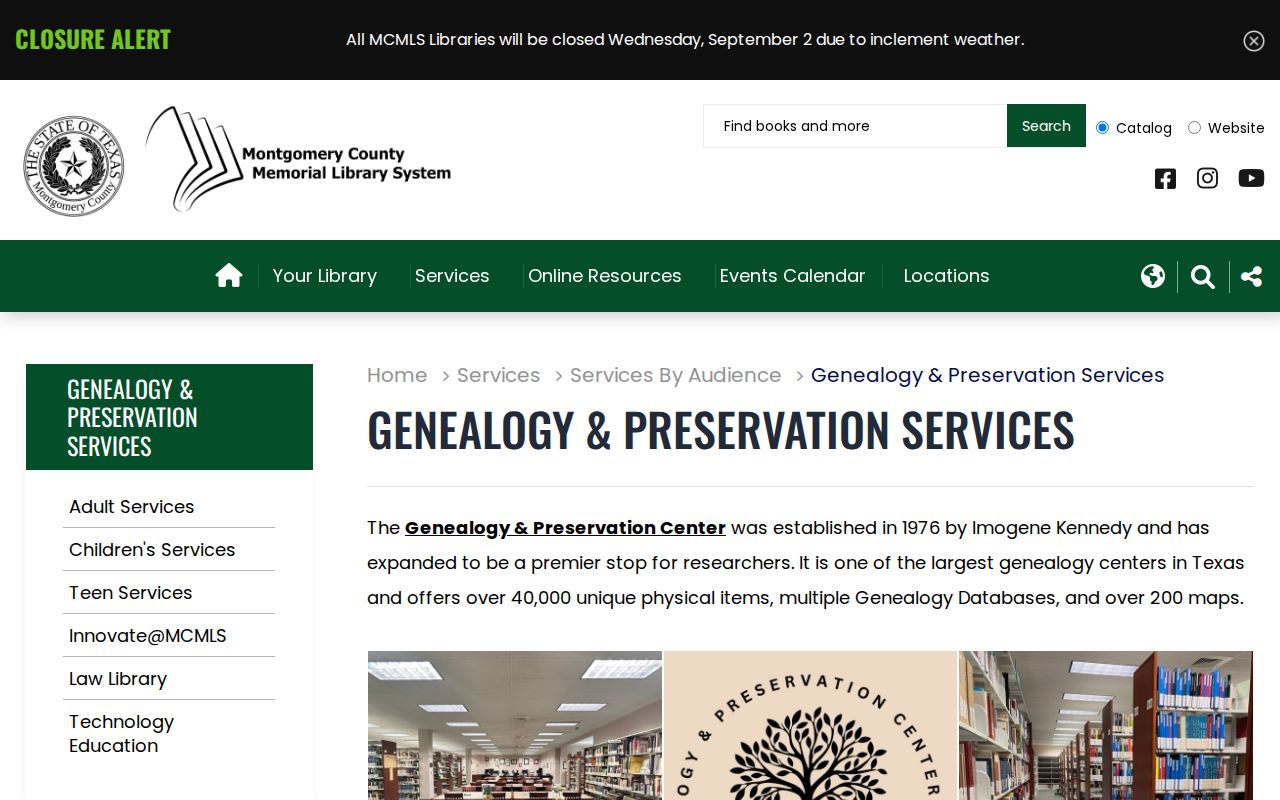
The center is at 104 I-45 N, Conroe, TX 77301, phone 936-522-2138. It lists 45-minute genealogy appointments, and its published schedule was Monday through Thursday 9 to 6, Friday through Saturday 9 to 5, closed Sunday. Check the library’s live schedule before traveling.
Previous Residents Source Comparison
The modern official-records index, historic microfilm, and local genealogy shelves serve distinct jobs. The portal is fastest for a known instrument, party, subdivision, or date. Microfilm reaches older Montgomery records and documents where indexing is incomplete. Library maps, vertical files, and newspapers can explain a place name or identify a lead. None of the three replaces the others, and none should be merged into one unsourced account of who lived at an address.
Comparison tip. Keep a short log with the source, date searched, exact search term, record number, legal description, and the result or gap. It makes a later correction possible.
Document The Woodlands Past Households
Build a household timeline by pairing a directory or newspaper date with the closest available land record and map context. Write down the edition year, publication page, instrument number, parcel identifier, legal description, and source date. Where an identity remains uncertain, retain the competing matches instead of joining people solely because a name or ZIP is similar. Census, obituary, probate, and marriage research can add context, but each has its own access limits and date range.
Use a simple dated flow: record the directory edition or Courier date, compare it with the deed or plat closest in time, then use a released census record or other original source only to test the household context. Return to the legal description whenever the street address or postal label changes. This process keeps a historical lead tied to its source date instead of turning it into a claim that extends beyond the record.
MCMLS, TSLAC, FamilySearch, and the Montgomery County Genealogical and Historical Society can help locate historical materials. The historical society is a context source, not a substitute for a primary land record. Its site lists research and publications, but the detailed catalog, appointment rules, and fees were not captured. Confirm those details directly before relying on them.
Lawful use. Use historic address research for family history, house history, estate questions, and civic context. Do not use old records to stalk, harass, track, or harm a living person.